 Kusama
 Kusama links validator activity to KSM staking rewards
· updated
Kusama links staking rewards to the work of elected validators and the KSM that backs those validators. Nominated proof of stake, or NPoS, determines active backing; era points measure credited validator activity. A nominator's eventual share also reflects the validator's commission and total backing for that era. Bonding tokens alone does not establish reward eligibility. Direct nominations and nomination pools provide different ways to participate, while payout records distinguish an earned allocation from KSM received in an account.
Greater total backing reduces rewards per nominated KSM when the validator's reward allocation and commission remain unchanged.
Direct nomination keeps validator selection with the account
If you want to select validators yourself, direct nomination gives your account that responsibility. Its stake must qualify for election inclusion and back elected validators. A nomination pool combines members' contributions into a single nomination position. Its authorized nominator selects validators for members. Pools can accommodate contributions below the threshold for active direct nomination, subject to their own joining requirements. Their combined stake still needs active backing to earn rewards. An account can use separate balances for pool membership and direct nomination; interface support for managing both can vary. Joining a pool does not give each member authority to change its nominations.
Asset Hub holds staking records while validators secure the relay chain
Staking balances and operations belong on Kusama Asset Hub following the migration completed on October 7, 2025. Validators continue their consensus and parachain-validation work on the relay chain. Asset Hub collators remain distinct from the relay-chain validators that nominators select. The migration preserved account ownership and moved existing staking information without requiring holders to recreate their nominations. Earlier transaction history remains associated with the chain where those transactions occurred. Consequently, an old relay-chain view can be incomplete for present staking balances or rewards.
The account address alone cannot identify which chain supplied a displayed balance. An incomplete chain view can therefore make an existing staking position appear empty.
Elections turn selected candidates into active backing
A selected candidate contributes to rewards only when the election assigns stake behind an elected validator. NPoS considers nomination preferences and bonded balances when assembling the validator set and its backing. The election seeks substantial support distributed across validators. A nomination list does not prescribe equal allocations to its selected candidates. Actual backing can change between eras even when the account leaves its nomination preferences unchanged. Era exposure records identify the stake behind each validator.
An elected validator can appear inactive for a nominator whose stake supports another elected candidate. A waiting candidate has not joined the active validator set for that era. The minimum bond for submitting nominations also differs from the dynamic minimum active stake. The former governs entry into the nomination role; the latter reflects an election outcome and can change as competing stake changes.
Era points connect validator work with reward allocations
When a validator performs credited work, era points determine its share of the era-point reward allocation. Points are accounting records for a reward cycle, which the network calls an era.
BABE governs relay-chain block production, while GRANDPA provides finality for the agreed chain. Validators also check parachain candidates against the rules of the relevant parachain. The reward system credits specific activities, including relay-chain block production and parachain validity statements.
Each validator's era-point reward allocation is proportional to its share of the era's total points. Total points provide the denominator, so a validator's raw count alone cannot establish its share. A higher raw count can represent a smaller fraction if total points rise faster. Additional nominated KSM does not itself give a validator extra points.
An elected validator that earns no points receives no allocation from this reward component. Its nominators consequently receive no share of that component for the era, even though their stake backed it.
Changing work assignments explain differences between eras
Parachain-validation assignments give selected validators additional opportunities to perform work that earns era points. Those assignments rotate, and block-production opportunities also vary. A lower total in an isolated era therefore need not establish persistent poor performance. Comparisons across completed eras reveal whether differences track temporary assignments or recur alongside missed activity.
Commission and active stake determine the nominator's share
Applicable validator commission comes out before the remaining era allocation is divided proportionally among active stake. The denominator includes the validator's own stake and the active nominator stake recorded behind it. Each nominator receives the fraction attributable to its allocated stake, not its entire wallet balance or every KSM that it has bonded.
Equal era-point allocations can therefore produce different rewards per nominated KSM. Greater backing divides the same residual allocation among more stake. A validator with less backing can deliver a larger reward per token under otherwise identical conditions. Election and credited work still determine whether the validator receives an allocation.
Commission is a percentage of the validator reward allocation, rather than a charge on the nominator's principal. If it consumes the entire allocation, no residual reward remains for nominators. Changes to commission can affect later eras, so historical rewards must use the preferences recorded for their own era. Applying today's displayed commission to an earlier reward can produce an incorrect explanation of the payment.
A pool may apply its own commission to rewards that reach its nomination position. That deduction is separate from validator commission and precedes distribution to members in proportion to their shares.
The staking ratio influences the reward budget
KSM issuance and the network's reward model determine the budget available to stakers. The proportion of total token issuance committed to staking influences its distribution between staking rewards and the treasury. Era points then allocate the staker budget among validators. An account's reward rate therefore depends on network-wide inputs as well as its own backing. An annualized yield changes as participation and reward allocations change.
That network-wide staking ratio differs from a validator's commission and an account's return on bonded KSM. Governance can change economic parameters, so a percentage copied from an older staking discussion should not be treated as a permanent network rule. KSM rewards also measure token income; a change in the token's market value can move the monetary result independently.
Payout records distinguish earned rewards from received KSM
A completed era establishes the reward allocation; a payout transaction distributes the corresponding rewards to recipients. Anyone can trigger the validator's eligible payout. The caller does not gain authority to redirect another nominator's reward. Validator exposure can span several pages, allowing reward distribution to fit within transaction limits. Paying one page does not prove that every nominator behind the validator has received a payment. The claim record identifies completed pages for that validator and era. A submitted transaction can still fail or remain pending. Successful dispatch and the relevant reward event establish a payment.
Era-point records can remain after rewards have been claimed. Their presence shows credited activity, not an outstanding balance awaiting payout. A pending claim therefore needs both an eligible reward allocation and an unpaid exposure page. Reward events identify the recipient and paid amount.
Reward history has a bounded claim window governed by the staking runtime's history-depth setting. Once an era falls outside that window, its unclaimed staking rewards expire. Pool members also have a separate claim against the pool's reward accounting after validator rewards reach the pool. A completed validator payout does not establish that every member has withdrawn or compounded their individual pool rewards.
Slashing ties staking losses to validator conduct
A nominator's bonded KSM can be slashed when it backed a validator that committed a qualifying offense. Equivocation involves conflicting signed statements, such as incompatible blocks or votes. Invalid parachain-validation statements can also lead to penalties. The offense and historical exposure determine who bears the loss.
Missed rewards and slashing are different consequences. A validator can receive little or no reward because it earns insufficient points, while a qualifying offense can remove principal. Penalty processing can occur after the relevant work period. Changing nominations or starting to unbond does not automatically cancel exposure to an earlier offense. Pool participation retains this connection to the selected validators, with losses reaching affected members through the pool's staking accounting.
Active backing determines whether more stake or different nominees can help
Consider a bonded KSM account that has no active backing in a completed era. Reward eligibility is missing before validator performance becomes relevant. Increasing its bond and changing its selected validators address different causes.
- Confirm that nomination preferences exist. A bonded balance alone does not identify validators that the account wishes to support.
- Compare the bonded amount with the active-stake threshold and election inclusion. Increasing the bond can address insufficient considered stake.
- Identify whether any selected candidates were elected. Replacing unelected candidates can address a selection problem; additional stake alone cannot assure their election.
- Use the later era's exposure records to establish whether the account actually backed an elected validator after the change.
- Assess that validator's credited points and the resulting claim separately. Active backing establishes participation, while points and distribution determine the reward.
The observable change is the account's stake appearing in an elected validator's era exposure. A successful bonding or nomination transaction does not by itself prove that transition. If backing already existed, neither action explains an unpaid reward from the earlier era.
Reward destinations and unbonding change the usable balance
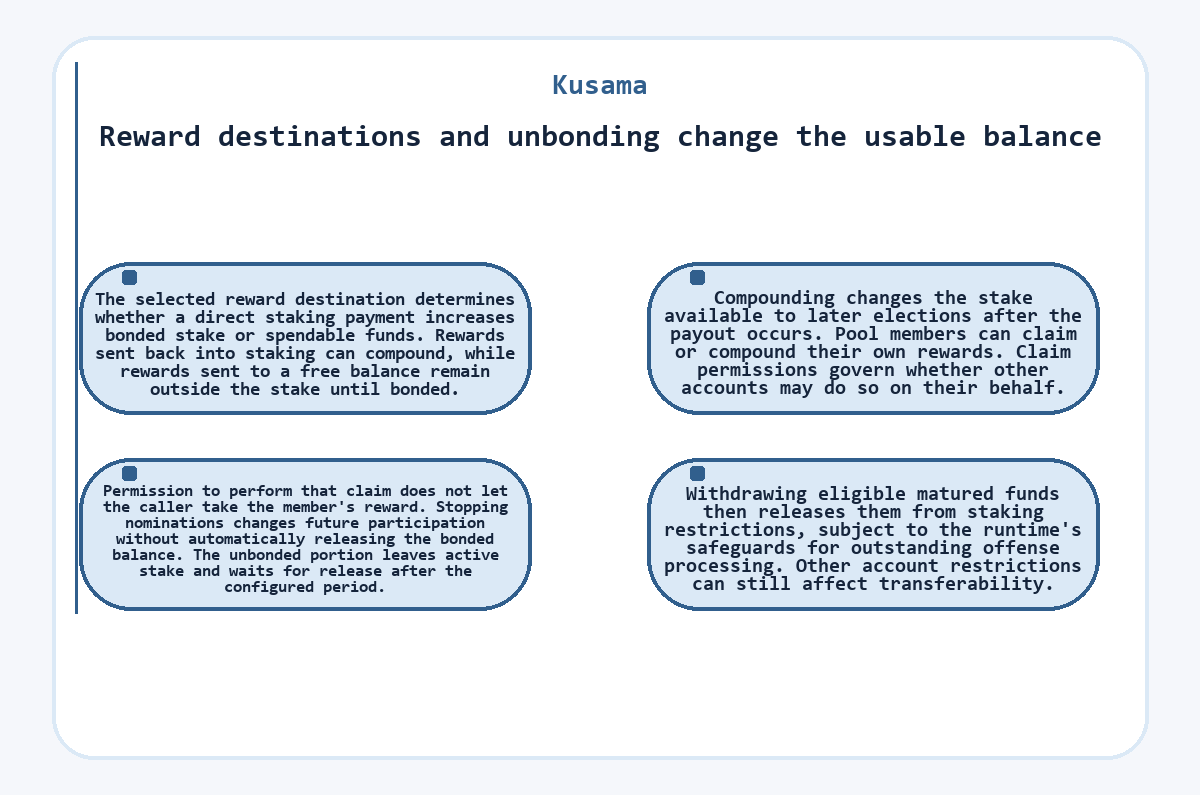
The selected reward destination determines whether a direct staking payment increases bonded stake or spendable funds. Rewards sent back into staking can compound, while rewards sent to a free balance remain outside the stake until bonded. Compounding changes the stake available to later elections after the payout occurs. Pool members can claim or compound their own rewards. Claim permissions govern whether other accounts may do so on their behalf. Permission to perform that claim does not let the caller take the member's reward.
Stopping nominations changes future participation without automatically releasing the bonded balance. The unbonded portion leaves active stake and waits for release after the configured period. Withdrawing eligible matured funds then releases them from staking restrictions, subject to the runtime's safeguards for outstanding offense processing. Other account restrictions can still affect transferability.
Helpful answers about Kusama
Can I earn KSM staking rewards while my wallet is offline?
An offline wallet does not prevent an existing active nomination from earning KSM rewards. Validator nodes perform the rewarded work, and staking records remain on-chain when the wallet disconnects. Your signing device is needed when you authorize changes or claims that require your signature. Its connection status does not substitute for validator performance or active backing.
Does nominating several validators run by one operator diversify staking risk?
Several validator addresses under one operator can share operational risks. Separate validator accounts do not establish separate infrastructure, signing-key management, or maintenance decisions. An outage or configuration mistake affecting shared systems can affect multiple validators. Each node still has its own credited activity and exposure, so the number of nominated addresses alone does not measure operator diversity.
Are Kusama era points transferable separately from KSM?
Era points are staking accounting records, not a transferable asset or separate reward token. They record credited validator activity within an era and help determine the reward allocation. The payout uses KSM. These records differ from nomination-pool points, which represent a member's share of the pool's funds.
How does a verified validator identity affect KSM staking rewards?
A verified validator identity concerns registered identity details, rather than the size of its staking reward. The judgment can help connect the validator account with its declared operator and contact information. Credited activity, commission, and active backing determine rewards. Identity verification does not establish that the node has completed its assigned duties or that its future operation will avoid offenses.
Is a separate controller account required to nominate KSM?
A separate controller account is no longer required for KSM staking. The stash account authorizes staking operations, with an optional staking proxy for delegated management. Older instructions that require creating a controller describe an earlier account model. Proxy permissions determine which actions a delegate can perform; a restricted staking proxy does not provide general authority to transfer the stash account's balance.